Thirty Seconds
There are very few things I'd willingly get out of bed at 2:30 in the morning for.
A flight.
A family emergency.
Mango going bust and selling everything at $1.
A half marathon probably shouldn't make the list, and yet there I was, getting dressed while the rest of the house slept.
One of the peculiar things about races in Malaysia is that they often start at four o'clock in the morning. It's the only sensible way to run 21 kilometres before the heat becomes ridiculous. Not the humidity mind. That’s still raging.
Which means that, at four o'clock, in almost complete darkness, thousands of people are standing on a start line.
No spectators.
Of course there aren't.
It's four o'clock in the bloody morning.
Nobody is dragging the family out of bed to stand on the side of the road and clap strangers before sunrise.
It's just thousands of people who've all independently decided that getting up in the middle of the night to run a half marathon sounds like a perfectly reasonable way to spend a Sunday.
It's gloriously odd when you stop and think about it.
Nobody's watching.
And yet we all turn up anyway.
The race itself went well. Not spectacularly, but well.
It was the first time I'd run this course and, if I'm honest, I probably left a little out there. I paced it sensibly. I never completely unravelled. I wasn't hanging on for dear life over the final few kilometres wondering whether I'd misjudged everything. Equally, I don't think I crossed the line thinking there was absolutely nothing left to give.
It felt like a solid run.
As I crossed the finish line, a volunteer walked towards me with a lanyard.
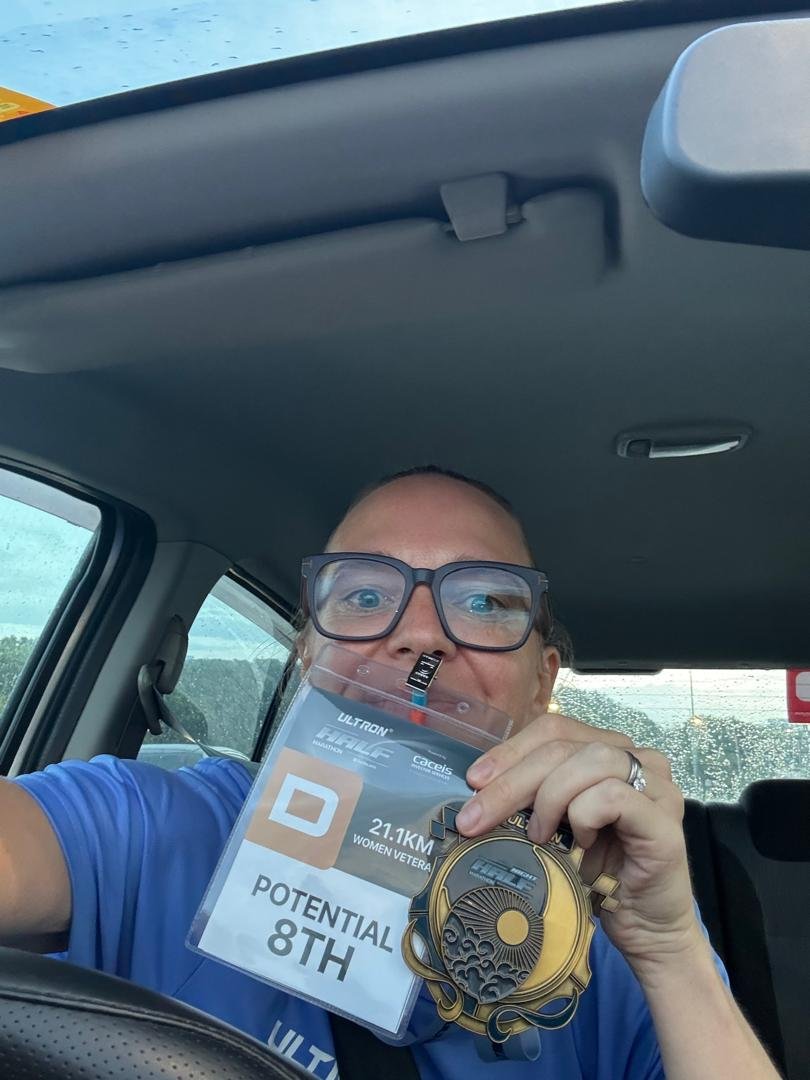
"Eighth."
For about thirty seconds I was absolutely delighted.
I'd never placed in the top ten before.
Now, before anyone imagines I've quietly become an elite athlete, I should point out this was in the female veteran category. The field is smaller once you're looking at women over forty. Even so, eighth place felt extraordinary. It represented years of quietly getting out for training runs when nobody particularly cared whether I did them or not.
Then someone mentioned I'd crossed the line ten seconds behind seventh.
Less than six minutes behind fifth.
The lanyard was still around my neck, but I'd already left eighth place behind.
Now the interesting thing is how quickly my mind moved from I've never placed top ten before to I could have done more.
Maybe I'd been too conservative.
Maybe I'd have caught seventh if I'd pushed harder over the final kilometre.
Maybe fifth wasn't completely unrealistic.
Maybe I should get straight back into training.
Almost annoyed with myself.
If only I'd...
Thirty seconds.
That's roughly how long I allowed myself to enjoy something I'd never achieved before.
The strange thing is, I don't think this is really about running. I've done exactly the same thing after workshops that have gone well, after winning work I'd spent months trying to secure, after reaching goals that had occupied far more of my headspace than I'd care to admit.
The achievement arrives. It gets acknowledged.
And almost immediately my attention shifts to what could have been better, what comes next or how much further there still is to go.
Somewhere along the way, the finish line became another starting line.
Perhaps that's part of what drives people who like making progress. Perhaps it's the very thing that gets us to eighth place in the first place.
But I can't help wondering whether the same instinct that keeps us moving forward also prevents us from ever really arriving.
Whether we've become so practised at chasing the next thing that we've forgotten how to stay with the thing we've already achieved.
I don't mean settling. Or lowering our expectations. Or deciding that eighth is enough and we needn't bother trying for fifth.
I simply wonder whether ambition and appreciation have somehow become mutually exclusive.
As though acknowledging something good might somehow blunt the edge we've worked so hard to sharpen.
What if it doesn't?
What if celebrating where we've arrived doesn't stop us wanting to see what's possible next?
What if the two things can exist together?
Because if a friend had crossed that finish line after years of training and someone had handed her a lanyard for placing eighth, I wouldn't have spent thirty seconds congratulating her before telling her she could probably have come fifth.
I'd have made a fuss. I'd have insisted on a photo. I'd have reminded her that there was once a version of herself who would've thought this impossible.
Funny how naturally we offer that generosity to other people.
Funny how reluctant we are to extend it to ourselves.
Three things to try this month
Stay with the moment.
Before asking "What's next?", ask yourself, "What just happened?"
Notice when the goalposts move.
Listen for the moment your inner voice says, "Yes, but..." Curiosity is far more useful than judgement.
Separate ambition from appreciation.
One drives progress. The other allows you to experience it.
Continue the conversation
One of the reasons I write this newsletter each month is because stories have a way of opening conversations that advice rarely does.
That's exactly what sits at the heart of the Women in Leadership Community. Throughout this next year, I’m inviting women leaders to share one story that's shaped the way they lead before we continue the conversation all together. No workshop. Just one experience that's worth talking about.
If this month's story resonated because you recognised the pattern, not just in running but in your own life, I'd love to introduce you to the Vibrant Leader Project.
It's a coaching partnership at the intersection of women's leadership, health and wellbeing, designed for women who've achieved professional success but no longer feel like the healthiest, strongest or most confident version of themselves. Together, we rebuild the habits, routines and self-belief that allow you to thrive in leadership without compromising the person behind the title.
The goal isn't choosing between being an exceptional leader and looking after yourself. It's refusing to accept that those two things are in competition.