The Recovery Cost
My Garmin told me to seek medical assistance last month. Which felt a little dramatic. I wasn't ill. At least, I didn't feel ill.
I was working. Travelling. Running workshops. Training. Getting on planes. Coming home. Getting back online. Doing all the usual things I do.
I was a bit tired, perhaps. Work had been particularly busy. I'd had a fair amount of travel and several back-to-back trips. Stress was higher than usual, but nothing felt especially alarming.
My body, apparently, had a different assessment of the situation.
My blood pressure dropped. My digestion was awful. My HRV* fell and stayed low for around ten days. The quality of my sleep deteriorated. I started getting brain fog.

*HRV stands for Heart Rate Variability. It’s something my fancy watch measures! When your HRV falls, it doesn't mean your heart is just beating faster, it means the variation in time between your consecutive heartbeats has flattened out, making your rhythm rigid like a metronome. What this tells me is that my body, despite being asleep, is stuck in fight-or-flight mode. Instead of letting my heart rhythm fluctuate naturally in 'rest-and-digest' mode, a stressed nervous system is forcing a strict, uniform pace to keep me on high alert.
Then I went for an easy run.
Easy genuinely means easy. The sort of run that should barely register in terms of recovery. When I finished, my watch told me I'd need 48 hours.
Forty-eight hours.
This is not my normal.
I take my health and training pretty seriously. Partly because I enjoy it, but also because I genuinely believe you have to be fit to do this work.
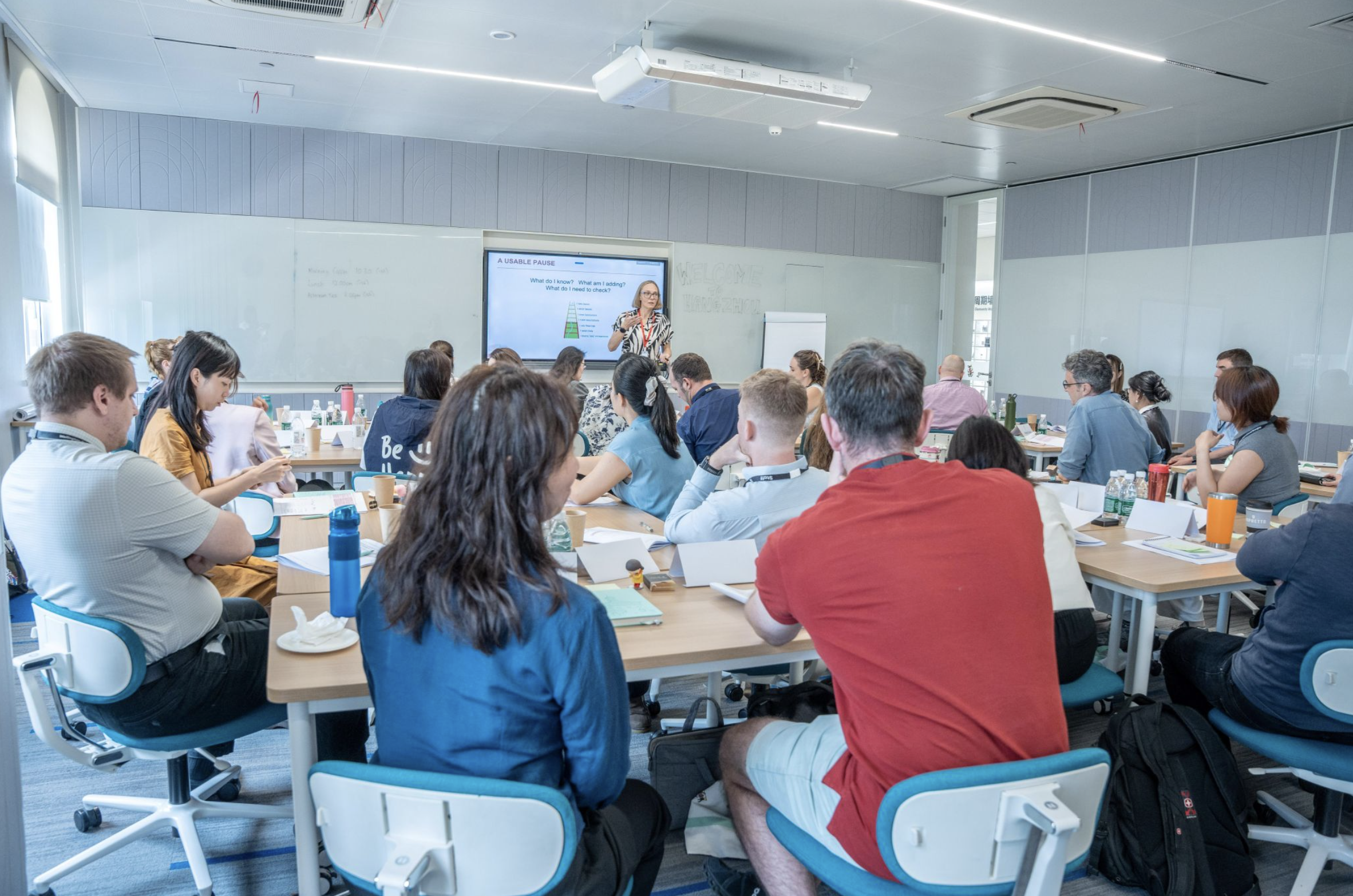
Facilitation takes more out of you than it looks like it should. You're standing for hours. You're reading a room constantly. You're listening, responding, changing direction, remembering what someone said three hours earlier and working out whether it needs to come back into the conversation. Add flights, hotels, early starts and unfamiliar food and the physical demands start to stack up.
Being fit has always helped me absorb that, and I've become very accustomed to my body absorbing it. Last month, it stopped doing that quite so efficiently.
The issue wasn't really what I could do. I could still do almost all of it. The issue was how long it was taking me to recover afterwards.
This, dear friends, is how the path towards burnout starts to look rather less dramatic than we'd like to imagine.
There was no collapse. No tearful phone call from an airport lounge. No doctor signing me off work. No lying on the sofa watching Netflix under a blanket.
I'm British and wasn't technically ill, so obviously none of that happened.
A few balls got dropped. I was less sharp than usual. I found things harder that normally wouldn't take much thought.
And I carried on.
There was one particularly ridiculous day when I took a six-hour flight home after a run of work trips and needed to be back online to facilitate a session at 4pm.
I had planned this. Nobody had done it to me. I'd looked at the itinerary and thought, Yep. That's fine. And, in fairness, I did it. I could do it.
I'm increasingly interested in how often those two words determine what we agree to.
I can….
There was technically enough time between landing and the session. There was technically enough energy to deliver it. There was technically enough of me left to keep the whole thing moving.
What I'd failed to account for was what any of it cost to recover from. Stress has an afterlife.
For years I've been pretty good at calculating whether I have enough capacity to do something. I'm much less practised at asking what I'll need afterwards.
It turns out, I'm also getting older. Annoying.
Despite my very best efforts, there may be some truth in the idea that I cannot keep throwing the same amount of intensity at my body and expect it to bounce back as quickly as it did ten years ago.
I don't particularly like this information.
I'm very attached to the idea that if I train hard, eat reasonably well and look after myself, I should be able to keep demanding quite a lot from my body, and I probably can. I just can't keep spending the recovery before I've had it.
There's been another, slightly unexpected, thing happening alongside all of this.
I've been reading Stolen Focus by Johann Hari.
It has made me notice how rarely my attention gets to go anywhere without being asked to produce something. I read constantly, but a lot of what I read has a job.
Books about leadership, adult learning, facilitation, psychology, health. Articles I might use in my work. Research that might strengthen something I'm writing. Ideas that end up scribbled in the margin and resurfacing moths later...
Even reading can become a productivity endeavour.
Lately I've found myself wanting to read fiction. Proper fiction. Stories with absolutely no obligation to improve my professional practice. I want to sit down with a book and have nothing useful come from it.
Perhaps there is something in the timing. My body has spent the last month asking for more space between periods of intensity. My brain, apparently, would also quite like to stop being mined for output every waking hour.
I've started wondering how often I look at the gaps between things and assume they're available and fillable. On paper, the time is free. My body may already have plans for it.
There is always something else that fits. Until it doesn't.
I'm still going to train hard. I'm still going to get on too many planes. There will absolutely be weeks when my diary looks ridiculous and I wonder who the idiot was who organised it (that would be me btw).
I also know now that Can I do it? isn't quite enough information. I'm trying to ask one more question.
What will it cost me to recover from it?
That changes the maths.
Three things to try this month
Know your normal. Pay attention to what is ordinary for you. Energy, sleep, concentration, patience, training, digestion. Whatever your markers are. Changes are much easier to notice when you know what you're comparing them with.
Count the recovery cost. When you're deciding whether something fits, look beyond the hours it occupies. Ask what you're likely to need afterwards too.
Do something gloriously unproductive. Read the novel. Walk without listening to anything. Sit somewhere without turning the experience into content. I'm going to attempt this one myself.
Recommendations for unproductive (but decidedly satisfying) reads welcome!